Antonyms
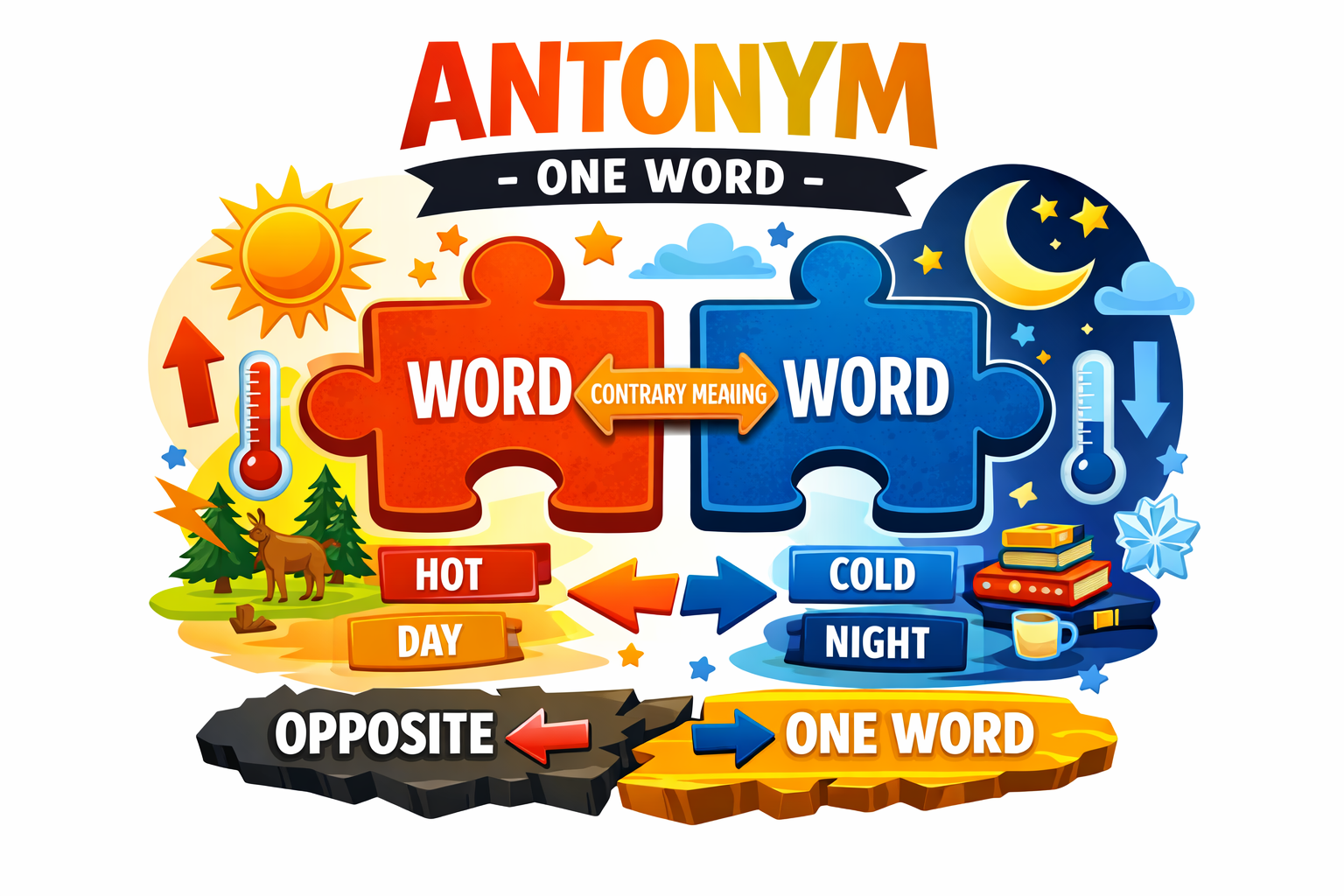
A word that has the exact opposite meaning of another word is its antonym. A word that expresses a meaning opposed to the meaning of another word, in which case the two words are antonyms of each other
Understanding antonyms helps learners identify opposite meanings, improve vocabulary, and choose the correct opposite according to the exact meaning of a word in a sentence. In exam questions, the best antonym may depend on the word, its usage, and the surrounding context.
What are Antonyms?
Antonyms are words that have opposite or nearly opposite meanings. They help us understand contrast, comparison, and change in meaning.
For example, the antonym of hot is cold, the antonym of happy is sad, and the antonym of begin is end.
| Word | Antonym | Meaning Contrast |
|---|---|---|
| Happy | sad | feeling good ↔ feeling unhappy |
| Big | small | large in size ↔ little in size |
| Fast | slow | moving quickly ↔ moving with less speed |
| Begin | end | to start ↔ to finish |
“To find the antonym, first understand the exact meaning of the given word.”
Vocabulary Tip
Key Points
- Antonyms are opposite meaning words.
- Some opposites are direct: hot ↔ cold.
- Some opposites depend on context.
- Prefixes can also create opposites.
- In exams, choose the closest opposite in the given context.
Types of Antonyms
Antonyms can be grouped according to the type of opposite meaning they show.
Direct Opposites
Words with clear opposite meanings.
- hot ↔ cold
- day ↔ night
- high ↔ low
Gradable Opposites
Opposites that can have degrees.
- big ↔ small
- rich ↔ poor
- young ↔ old
Relational Opposites
Words that show opposite roles or directions.
- buy ↔ sell
- give ↔ receive
- teacher ↔ student
Prefix-based Opposites
Opposites formed using prefixes.
- happy ↔ unhappy
- possible ↔ impossible
- agree ↔ disagree
Context-Based Antonyms
In context-based antonym questions, the correct opposite depends on how the word is used in the sentence. The same word may have different meanings and therefore different antonyms.
For example, the word light can have different meanings and different antonyms:
- Light bag means not heavy; its antonym is heavy.
- Light colour means pale; its antonym is dark.
- Light meal means small; its antonym is heavy or large.
- Light a candle means ignite; its antonym may be extinguish.
| Sentence | Word | Context Meaning | Best Antonym |
|---|---|---|---|
| The bag is very light. | light | not heavy | heavy |
| She wore a light blue dress. | light | pale in colour | dark |
| He gave a brief speech. | brief | short in duration | long |
| The patient is in a grave condition. | grave | serious | minor / safe |
“In context-based antonyms, the sentence decides the opposite.”
Vocabulary Tip
How Context Changes Antonym Choice
Many words change meaning according to the noun, verb, tone, or situation in the sentence. The antonym must match that particular meaning.
Meaning from Noun
The noun after the word gives an important clue.
- heavy bag ↔ light bag
- heavy rain ↔ light rain
- heavy traffic ↔ light traffic
Meaning from Verb
The action in the sentence changes the opposite.
- raise salary ↔ reduce salary
- raise a question ↔ answer a question
- raise your hand ↔ lower your hand
Meaning from Tone
Positive or negative tone affects the antonym.
- bold decision ↔ timid decision
- rash decision ↔ careful decision
- calm voice ↔ agitated voice
Meaning from Situation
The overall situation decides the best opposite.
- bright future ↔ bleak future
- bright light ↔ dim light
- bright student ↔ dull student
Mini Antonym Bank
clean ↔ dirty
strong ↔ weak
accept ↔ reject
remember ↔ forget
brave ↔ afraid
calm ↔ worried
abundant ↔ scarce
expand ↔ contract
Tip: Learn antonyms in pairs. It improves both vocabulary and sentence understanding.
Mini Context-Based Antonym Bank
light colour ↔ dark colour
light meal ↔ heavy meal
sharp mind ↔ dull mind
sharp pain ↔ mild pain
hard question ↔ easy question
hard worker ↔ lazy worker
clear answer ↔ confusing answer
clear sky ↔ cloudy sky
Tip: Prepare one word with different sentences. Then write its opposite for each sentence.

Common Exam Antonyms
| Word | Closest Antonym | Meaning | Example Sentence |
|---|---|---|---|
| Abundant | scarce | available in large quantity | Water was abundant after the rains. |
| Ancient | modern | very old | The museum displayed ancient coins. |
| Brave | cowardly | showing courage | The brave child spoke the truth. |
| Calm | agitated | peaceful and relaxed | She remained calm during the test. |
| Expand | contract | to become larger | Metals expand when heated. |
| Honest | dishonest | truthful and fair | He is an honest worker. |
| Increase | decrease | to become more | The price may increase next month. |
| Victory | defeat | success in a contest | The team celebrated its victory. |
Note: In competitive exams, the answer is usually the word that is most opposite in meaning in the given context.
Context-Based Exam Examples
| Sentence | Word | Best Antonym | Why? |
|---|---|---|---|
| The officer gave a sound suggestion. | sound | unsound / foolish | Here, sound means wise or sensible. |
| The doctor said the injury was minor. | minor | serious / major | Here, minor means not serious. |
| The student gave a clear explanation. | clear | confusing | Here, clear means easy to understand. |
| The company decided to cut expenses. | cut | increase | Here, cut means reduce. |
| She has a bright future. | bright | bleak | Here, bright means promising. |
| He gave a fine performance. | fine | poor | Here, fine means excellent or very good. |
| The rule is strict. | strict | lenient | Here, strict means firm or not flexible. |
| The road is narrow. | narrow | wide | Here, narrow refers to width. |
Note: In context-based antonym questions, options may be opposites in general, but only one will fit the sentence exactly.
Practice
A) Choose the Closest Antonym
-
Antonym of rapid:
quick slow fast swift
-
Antonym of ancient:
old past modern historic
-
Antonym of courageous:
brave bold fearful heroic
-
Antonym of accept:
receive approve reject allow
B) Choose the Context-Based Antonym
-
The child gave a bright answer in class.
shining dull colourful burning
-
The judge gave a fair decision.
light unjust beautiful average
-
The company will raise the salary next month.
lift reduce bring up question
-
The patient is in a grave condition.
serious safe deep silent
-
The rule is very strict.
firm rigid lenient serious
C) Fill in the Blanks: General Antonyms
- The box is not heavy; it is very ________. (Use an antonym of heavy)
- Do not forget your homework; please ________ it. (Use an antonym of forget)
- The road is not wide; it is ________. (Use an antonym of wide)
- The answer is not wrong; it is ________. (Use an antonym of wrong)
D) Fill in the Blanks: Context-Based Antonyms
- The knife is not sharp; it is ________. (Use the contextual antonym of sharp)
- The question was not hard; it was ________. (Use the contextual antonym of hard)
- The water was not clear; it was ________. (Use the contextual antonym of clear)
- The traffic was not heavy; it was ________. (Use the contextual antonym of heavy)
- The explanation was not clear; it was ________. (Use the contextual antonym of clear)
E) Match the Words with Their Antonyms
| Word | Options |
|---|---|
| Begin | start / open / end / grow |
| Huge | large / tiny / broad / tall |
| Silent | quiet / peaceful / noisy / calm |
| Beautiful | pretty / lovely / ugly / graceful |
F) Match the Word with Its Contextual Antonym
| Sentence | Options |
|---|---|
| The officer gave a sound suggestion. | wise / foolish / healthy / musical |
| She wore a light green saree. | heavy / dark / easy / small |
| He has a sharp mind. | pointed / dull / sudden / painful |
| The meeting was brief. | short / long / detailed / heavy |
| The sky was clear. | cloudy / simple / visible / clean |
G) Short Reading: General Antonyms
The brave boy helped a weak old man cross the wide road. It was a bright morning, and the street was very busy.
Task: Find suitable antonyms for the bold words in the paragraph.
H) Short Reading: Context-Based Antonyms
The principal gave a brief speech and made a sound decision about the school event. The students gave bright answers during the quiz, but one question was quite hard. The teachers gave a clear explanation after the test.
Task: Find suitable context-based antonyms for the bold words in the paragraph.
Show Suggested Answers
A) Closest Antonym
- slow
- modern
- fearful
- reject
B) Context-Based Antonym
- dull
- unjust
- reduce
- safe
- lenient
C) General Fill in the Blanks
- light
- remember
- narrow
- right / correct
D) Context-Based Fill in the Blanks
- blunt
- easy
- muddy
- light
- confusing
E) Matching
- Begin → end
- Huge → tiny
- Silent → noisy
- Beautiful → ugly
F) Contextual Matching
- sound suggestion → foolish
- light green saree → dark
- sharp mind → dull
- brief meeting → long
- clear sky → cloudy
G) General Reading Antonyms
brave → cowardly / fearful
weak → strong
wide → narrow
bright → dull / dark
busy → quiet / free
H) Context-Based Reading Antonyms
brief → long
sound → foolish / unsound
bright → dull
hard → easy
clear → confusing / unclear
Exam Tips
- First understand the meaning of the given word.
- Then look for the most opposite meaning.
- Read the complete sentence before choosing the antonym.
- Find the contextual meaning of the highlighted word.
- Check whether the word is used as a noun, verb, or adjective.
- Do not choose an opposite that fits another meaning of the word.
- Do not confuse synonyms with antonyms.
- Eliminate synonyms and unrelated words first.
- Learn common prefix-based opposites: un-, in-, im-, dis-, non-.
Select a topic and chapter from the left menu.